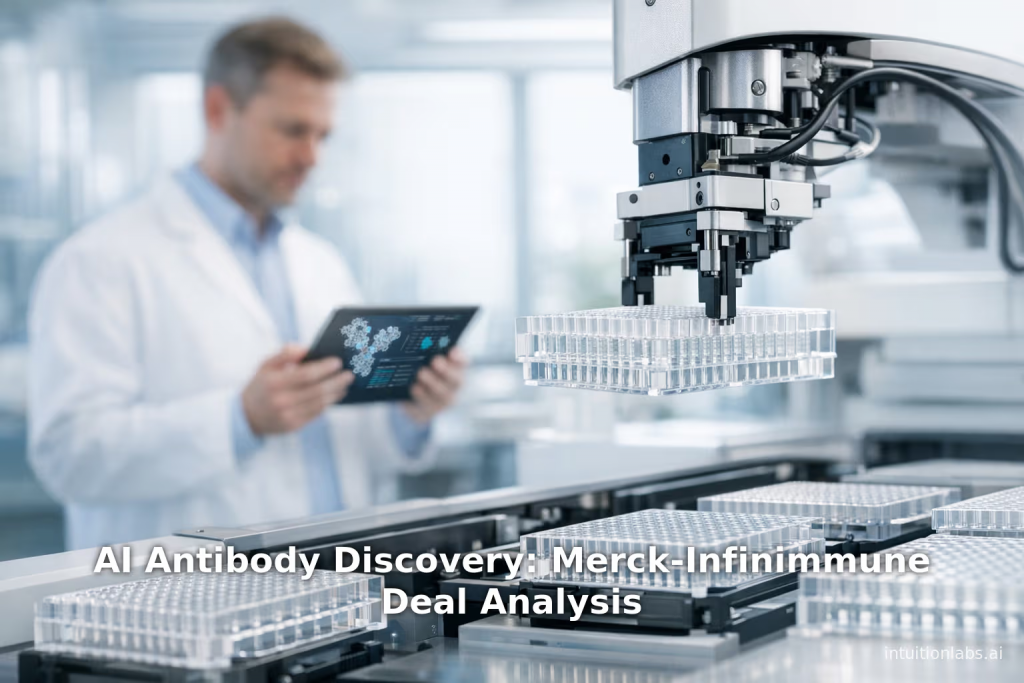
AI Antibody Discovery: Merck-Infinimmune Deal Analysis
来源:IntuitionLab | 发布时间:2026-06-30
摘要:默克(Merck & Co.)与生物技术公司Infinimmune达成最高价值8.38亿美元的多靶点抗体发现合作,由Infinimmune利用Anthrobody™平台(筛选人体记忆B细胞获取天然全人源抗体序列)结合专有的GLIMPSE™抗体语言模型(进行AI驱动的序列优化与亲和力成熟)为默克发现新型单抗药物,默克支付预付款及里程碑款并享有全球独家开发与商业化权。文章指出该交易反映了大型药企为应对专利悬崖积极布局AI赋能的生物药研发,Infinimmune"以人体免疫系统为起点、以AI解码进化逻辑"的人源优先策略有望缩短候选分子发现周期并提升抗体可开发性,若成功将验证AI蛋白质语言模型在抗体工程中的产业化价值。
AI 抗体发现:默克与 Infinimmune 合作协议分析
German techbio company Lucera has launched with ambitions to improve decision-making across pharmaceutical research and development using artificial intelligence (AI) and a curated biomedical knowledge base.德国生物科技公司 Lucera 已正式成立,其愿景是借助人工智能(AI)和经过筛选的生物医学知识库,优化药物研发全流程的决策能力。
The Heidelberg-based company was formed after a consortium of life sciences and private equity investors acquired the pharmaceutical technology business of Molecular Health.这家总部位于海德堡的公司是在一个生命科学与私募股权投资者联盟收购了 Molecular Health 的制药技术业务后成立的。
Executive Summary 执行摘要
In March 2026, Merck & Co. announced a landmark $838 million collaboration with California biotech Infinimmune to leverage its AI-driven “human-first” antibody discovery platform for developing novel biologics ([1]) ([2]). Under the multi-target agreement, Merck (MSD outside North America) will supply an undisclosed upfront payment and^ up to $838 million in milestone payments to Infinimmune. Once Infinimmune identifies a promising fully-human antibody candidate, Merck obtains exclusive rights to further develop and commercialize it ([1]) ([3]). This pact reflects Merck’s strategic push into AI-enabled biologics discovery amid looming revenue pressures (e.g. the impending 2028 patent cliff for Keytruda ([4])). It exemplifies a broader industry trend of nine-figure AI-partnerships in drug development ([5]) ([6]).2026年3月,默克公司宣布与加州生物科技公司Infinimmune达成一项具有里程碑意义的合作,交易金额达8.38亿美元。双方将依托Infinimmune由人工智能驱动的“以人类为中心”的抗体发现平台,开发新型生物制剂([1])([2])。根据这项多靶点合作协议,默克公司(北美以外地区称为MSD)将向Infinimmune支付一笔未公开的预付款,以及最高8.38亿美元的里程碑付款。一旦Infinimmune筛选出有潜力的全人源抗体候选药物,默克将获得其进一步开发和商业化的独家权利([1])([3])。在收入压力日益凸显的背景下(例如,Keytruda的专利即将在2028年到期),这一合作协议体现了默克向人工智能赋能的生物制剂研发领域战略布局的决心。这也印证了制药行业正掀起九位数人工智能合作热潮的整体趋势([5])([6])。
Infinimmune’s platform melds two core innovations: the Anthrobody™ screening platform, which mines millions of human memory B cells to find naturally occurring antibody sequences, and GLIMPSE™, a proprietary antibody language model trained on paired human antibody sequences ([7]) ([8]). Together, these technologies enable rapid isolation and in silico optimization of fully-human antibodies with strong affinity, specificity and drug-like properties ([7]) ([9]). In technical benchmarks, GLIMPSE-1 has achieved best-in-class humanization and up to 1000-fold affinity improvements in target antibodies, simultaneously engineering cross-species binding and eliminating developability liabilities ([10]) ([11]). These capabilities suggest GLIMPSE can effectively “decode” the evolutionary logic of the human immune system to design safer, more potent biologics from day one ([12]).Infinimmune的平台融合了两项核心创新:一是Anthrobody™筛选平台,该平台可挖掘数百万个人类记忆B细胞,以寻找天然存在的抗体序列;二是GLIMPSE™,这是一款专有的抗体语言模型,基于配对的人类抗体序列进行训练([7])([8])。这些技术协同作用,能够快速分离并通过计算机模拟优化全人类抗体,使其具备高亲和力、高特异性和类药物特性([7])([9])。在技术基准测试中,GLIMPSE-1实现了同类最佳的人源化效果,目标抗体的亲和力最高提升1000倍,同时还能赋予抗体跨物种结合能力,并消除可开发性风险([10])([11])。这些能力表明,GLIMPSE能够有效“解码”人类免疫系统的进化逻辑,从一开始就设计出更安全、更高效的生物制剂([12])。
The Merck–Infinimmune deal is expected to accelerate Infinimmune’s own pipeline while validating its approach: projects like IFX-101 (an IL-22 inhibitor) and IFX-201 (an IL-13 inhibitor for atopic dermatitis) are already in preclinical development, and first-in-human studies are targeted by 2026 ([13]) ([14]). More broadly, this partnership underscores how AI-driven antibody discovery—especially leveraging human immune repertoires—is emerging as a new paradigm in biologics R&D. Industry observers note that large pharma are eagerly investing in such platforms (e.g. Merck’s deals with AI antibody firms and its recent Terns Pharmaceuticals acquisition) in hopes of boosting pipeline productivity ([15]) ([16]). While AI-empowered candidates have yet to reach the clinic in force, deals like Merck–Infinimmune highlight a major shift: integrating machine learning into biologics discovery to tap the “450 million-year-old” immune engine inside each human ([17]) ([5]).默克与英菲免疫的合作交易预计将加快英菲免疫自身的研发管线,同时验证其技术路径:IFX-101(一种IL-22抑制剂)和IFX-201(一种用于特应性皮炎的IL-13抑制剂)等项目已进入临床前研发阶段,人体首次临床试验目标定于2026年开展[13][14]。从更广泛的角度来看,这一合作凸显了人工智能驱动的抗体发现——尤其是利用人类免疫库的技术——正成为生物制剂研发领域的新范式。行业观察人士指出,大型制药公司正积极投资此类平台(例如默克与人工智能抗体企业的合作交易,以及其近期对Terns Pharmaceuticals的收购),以期提高研发管线的产出效率[15][16]。尽管人工智能赋能的候选药物尚未大规模进入临床试验,但默克与英菲免疫这样的合作交易凸显了一项重大转变:将机器学习融入生物制剂研发,以挖掘每个人体内“拥有4.5亿年进化史”的免疫引擎[17][5]。
Introduction and Background 引言与背景
Antibodies in Therapeutics and Discovery Challenges治疗性抗体及研发挑战
Monoclonal antibodies (mAbs) have become a cornerstone of modern medicine, treating cancers, autoimmune diseases, infectious diseases and more. However, discovering optimal antibody therapeutics remains time-consuming and complex. Traditional approaches—such as immunizing animals, generating hybridomas, or engineering phage/yeast display libraries—can yield potent leads but often require extensive laboratory screening, suffer from sequence liabilities, and may not fully recapitulate human-biological safety profiles. For example, antibodies raised in animals often need humanization to reduce immunogenicity, a multi-step process. Even “humanized” mAbs can carry non-native sequences that may trigger immune responses. In contrast, antibodies directly sourced from the human immune system carry inherent “clinical proof” from nature, with built-in safety and efficacy advantages: humans produce approximately 100 billion new individual antibodies each day through natural exposure, far more diversity than any lab-based method can mimic ([18]).单克隆抗体(mAbs)已成为现代医学的基石,可用于治疗癌症、自身免疫性疾病、传染病等多种疾病。然而,开发最佳抗体疗法仍然耗时且过程复杂。传统方法——如给动物免疫、制备杂交瘤细胞或构建噬菌体/酵母展示文库——虽能获得有潜力的候选抗体,但往往需要大量的实验室筛选,存在序列缺陷,且可能无法完全复现人体生物学的安全性特征。例如,动物体内诱导产生的抗体通常需要进行人源化以降低免疫原性,而这是一个多步骤的过程。即便是“人源化”单克隆抗体,也可能携带非天然序列,进而引发免疫反应。相比之下,直接从人体免疫系统获取的抗体具备自然界赋予的天然“临床验证”优势,在安全性和有效性方面具有先天特点:人体每天会通过自然暴露产生约1000亿种全新的单一个体抗体,其多样性远超任何实验室方法所能模拟的水平([18])。
Emerging technologies aim to capitalize on human-derived repertoires. Single-cell sequencing tools (e.g. from 10x Genomics) can capture native heavy-and-light chain pairs from human B cells, scanning thousands of cells per run. Infinimmune extends these ideas: it calls its approach a “Complete Human sequencing technology®” with an “Anthrobody library-on-B-cell” platform ([19]). Infinimmune posits that by interrogating millions of human memory B cells (immune cells that have already “seen” disease-related antigens), one can surface fully-matched human antibody sequences against desired targets. These human-sourced antibodies are then believed to be “primed” for drug use, having passed through the selective bottlenecks of natural immunity ([20]) ([21]). The key insight is that the human body has been “running clinical trials for some 500 million years,” naturally evolving antibodies with optimal specificity, stability and tolerability ([18]) ([21]).新兴技术旨在利用人类来源的抗体库。单细胞测序工具(例如10x Genomics公司的产品)能够从人类B细胞中捕获天然的重链和轻链配对,每次运行可扫描数千个细胞。Infinimmune公司拓展了这些技术思路:其将自身技术方案称为“全人类测序技术®”</b>,并搭载“基于B细胞的人源抗体库”</b>平台([19])。Infinimmune公司认为,通过对数百万个人类记忆B细胞(即已经“接触”过疾病相关抗原的免疫细胞)进行检测,就能找到针对特定靶点的完全匹配的人类抗体序列。这些人类来源的抗体在经历了自然免疫的选择性瓶颈后,被认为已为药物应用做好了“准备”([20])([21])。其核心观点是,人体已经“开展了约5亿年的临床试验”,自然进化出了具有最佳特异性、稳定性和耐受性的抗体([18])([21])。
Nonetheless, simply collecting human antibodies is not enough.Millions of discovered antibody clones may still need refinement (to improve affinity, stability, or cross-reactivity to animal models for safety testing). This is where artificial intelligence (AI) enters. Advances in deep learning, especially protein language models, enable computational tools to suggest sequence edits. By training on large antibody sequence datasets, such models can predict which mutations might increase binding or human-likeness. In essence, AI can model the language of the immune repertoire and propose design improvements in silico ([8]). Recent academic and industry efforts (e.g. Merck’s “Sapiens” model ([22]) and open-source antibody LMs like AntiBert and GLUE) show that language-model approaches can nearly match human expert performance in antibody humanization benchmarks. The FDA’s recent push to phase out animal testing for biologics ([23]) further motivates these in silico strategies, since fully-human antibodies and AI designs could reduce reliance on murine immunization and extensive lab evolution.尽管如此,仅收集人类抗体还不够。数百万已发现的抗体克隆可能仍需优化(以提高亲和力、稳定性,或增强对动物模型的交叉反应性以进行安全性测试)。人工智能(AI)正是在此环节发挥作用。深度学习的进步,尤其是蛋白质语言模型,让计算工具能够提出序列编辑建议。通过在大规模抗体序列数据集上进行训练,此类模型可以预测哪些突变可能增强结合能力或更接近人类抗体的特征。本质上,AI 能够模拟免疫库的“语言”,并在计算机模拟中提出优化设计的方案[8]。学术界和工业界近期的相关研究(例如默克公司的“Sapiens”模型[22],以及 AntiBert、GLUE 等开源抗体语言模型)表明,在抗体人源化基准测试中,语言模型方法的表现几乎可与人类专家相媲美。美国食品药品监督管理局(FDA)近期推动逐步淘汰生物制品的动物测试[23],这进一步推动了这些计算机模拟策略的发展,因为全人类抗体和 AI 设计能够减少对小鼠免疫接种和大规模实验室进化的依赖。
Merck’s Strategic Context 默克的战略背景
Merck & Co. (known as MSD outside the U.S. and Canada) is a top-tier biopharmaceutical company with blockbuster oncology and immunology drugs (notably the PD-1 inhibitor Keytruda). With Keytruda’s patent expiry approaching in the next few years, Merck has aggressively sought to diversify its pipeline via acquisitions and R&D partnerships ([15]) ([4]). March 2026 was especially active: Merck agreed to buy Terns Pharmaceuticals for $6.7 billion (adding an oral CML candidate) and expanded its rights to Quotient’s genomics platform (for IBD targets) ([24]) ([16]). In this deal-flurry, Merck’s eye also turned to AI: partnering with startups that claim to accelerate drug discovery.默克公司(在美国和加拿大以外地区称为 MSD)是一家顶级生物制药公司,拥有重磅肿瘤学和免疫学药物(尤其是 PD-1 抑制剂可瑞达)。随着可瑞达的专利将在未来几年到期,默克积极通过收购和研发合作拓展其研发管线([15])([4])。2026 年 3 月尤为活跃:默克同意以 67 亿美元收购泰恩斯制药(新增一款慢性粒细胞白血病口服候选药物),并扩大了对 Quotient 基因组学平台(用于炎症性肠病靶点)的权利([24])([16])。在这一波并购热潮中,默克的目光也投向了人工智能:与声称能加速药物发现的初创公司展开合作。
Specifically, on March 31, 2026, Merck announced a multi-target antibody discovery collaboration with Infinimmune worth up to $838 million in potential payments ([2]) ([3]). The goal: use Infinimmune’s AI-driven, human-derived platform to find new monoclonal antibody (and related) drug candidates. Merck retains exclusive global rights to develop/commercialize any antibody arising from the collaboration, reflecting its strategy of externalizing early-stage discovery while keeping late-stage R&D in-house ([1]) ([3]). Merck’s biologics research chief Juan Alvarez commented that Infinimmune’s approach “offers a compelling new way to access novel biology and promising therapeutic candidates,” emphasizing the novelty of accessing the human immune repertoire for drug leads ([25]) ([26]).具体而言,2026年3月31日,默克宣布与Infinimmune达成一项多靶点抗体发现合作,潜在付款金额最高达8.38亿美元([2])([3])。合作目标为:依托Infinimmune人工智能驱动的人类源平台,研发新的单克隆抗体(及相关)药物候选物。默克保留合作产生的所有抗体的全球独家开发与商业化权利,这体现了其将早期发现环节外部化、同时将后期研发环节内部化的战略([1])([3])。默克生物制药研究负责人胡安·阿尔瓦雷斯表示,Infinimmune的技术方案“为探索新型生物学机制和极具潜力的治疗性候选药物提供了极具吸引力的新途径”,并强调了从人类免疫库中获取药物先导化合物的创新性([25])([26])。
From Merck’s perspective, this $838M pact is both a bet and a bridge. It doubles down on the idea (gaining traction industry-wide) that A) integrating machine learning into drug discovery is essential, and B) focusing on human-relevant data (immune repertoires, patient-derived cells) can yield superior leads ([5]) ([17]). Importantly, Merck is not paying this entire amount upfront – most is tied to milestones (clinical and commercial) across multiple targets ([1]) ([27]). This structure, common in pharma-BD deals, shares risk and aligns incentives. However, in aggregate it raises the potential payout to the same magnitude as several other blockbuster AI partnerships: for example, Merck KGaA’s AI-antibody alliance with Biolojic (up to €346M in milestones ([28])) or Novartis’s $65M upfront / $1B milestones deal with Generate Biomedicines (generative protein design) ([29]). The Merck–Infinimmune deal thus exemplifies a new “mega-deal” era where biotech and big pharma stake multihundred-million bets on AI-powered drug discovery ([5]) ([6]).从默克公司的角度来看,这份价值8.38亿美元的协议既是一场赌注,也是一座桥梁。它进一步坚定了两个在全行业逐渐获得认可的理念:一是将机器学习整合进药物研发至关重要,二是聚焦与人类相关的数据(免疫库、患者来源细胞)能够产出更优质的先导化合物([5])([17])。值得注意的是,默克并未提前支付全部金额——大部分款项与多个靶点的里程碑(临床和商业化)挂钩([1])([27])。这种在制药行业合作交易中常见的结构,既能分散风险,也能让双方激励机制保持一致。不过,总体来看,这笔交易的潜在回报金额与其他几笔重磅AI合作项目相当:例如,德国默克与Biolojic达成的AI抗体联盟(里程碑付款最高达3.46亿欧元([28])),或是诺华与Generate Biomedicines(蛋白质生成设计公司)达成的6500万美元预付款/10亿美元里程碑付款合作([29])。因此,默克与Infinimmune的这笔交易标志着一个全新的“大型交易”时代的到来——生物技术公司和大型制药公司都在押注数亿美元,布局AI驱动的药物研发领域([5])([6])。
Infinimmune’s Platform and Technology英菲免疫的平台与技术
Founded in 2022 by ex-10x Genomics engineers, Infinimmune positions itself as a pioneer of human-derived antibody therapeutics. Its proprietary platform has three chief components: (1) Anthrobody® screening technology, (2) Complete Human™ sequencing processes, and (3) the GLIMPSE™ antibody language model. Each was developed to tackle a challenge in antibody discovery and engineering, with an emphasis on leveraging actual human immune data at unprecedented scale.Infinimmune 由前 10x Genomics 工程师于 2022 年创立,定位为人源化抗体疗法的先驱。公司的专有技术平台包含三大核心组件:(1)Anthrobody®筛选技术、(2)全人源测序流程以及(3)GLIMPSE™抗体语言模型。每一项组件均为解决抗体发现与工程化领域的特定挑战而研发,重点以前所未有的规模利用真实的人类免疫数据。
Anthrobody Platform 人源抗体平台
The term “Anthrobody” (from anthro- meaning human) refers to Infinimmune’s high-throughput screening of native human memory B cells to discover antigen-specific antibodies already present in people ([7]) ([30]). In practice, the company isolates peripheral B cells from a diverse array of healthy and diseased donors. Using its sequencing pipeline, it can process tens to hundreds of millions of single B cells, each revealing the fully paired heavy and light chain sequences of an antibody. For context, the Infinimmune site claims screening “up to 300 million B cells across 350+ targets” in a campaign ([19]). The result is a vast “Anthrobody library-on-B-cell” where each entry is a fully-human antibody clone with known antigen specificity.“人体抗体”(Anthrobody)一词(源自表示“人类”的前缀anthro-)指的是 Infinimmune 公司对天然人类记忆 B 细胞开展的高通量筛选,以此发掘人体中已存在的抗原特异性抗体([7])([30])。实际操作中,该公司会从各类健康及患病供体中分离外周血 B 细胞。借助其测序流程,公司可处理数千万至数亿个单一 B 细胞,每个细胞都能呈现出抗体完整配对的重链和轻链序列。背景信息显示,Infinimmune 公司官网宣称,单次筛选项目可完成“350 个以上靶点的多达 3 亿个 B 细胞”的筛选([19])。最终形成的是一个庞大的“B 细胞级人体抗体库”,库中每个条目均为具有已知抗原特异性的全人类抗体克隆体。
This approach contrasts with conventional discovery in two ways. First, it captures native pairing and maturation – the heavy-light chain combinations that have already undergone selection inside a human immune system. By sequencing entire cells in situ (without shuffling chains), the platform preserves the natural CDR (complementarity-determining region) pairings that often determine developability. Second, by using real human donors, each antibody “carries the imprint of an evolutionary trial”: Infinimmune emphasizes that human-derived antibodies already satisfy major biophysical criteria (proper folding, low immunogenicity, self-tolerance) shaped by natural evolution ([17]) ([21]). Indeed, a company statement notes that their antibodies are “completely encompassing the full binding and effector regions of both chains” as produced by human immune responses – fundamentally different from antibodies raised in mice or from synthetic libraries ([21]).该方法在两个方面与传统发现方式形成对比。首先,它捕捉到天然配对与成熟过程——即已在人体免疫系统内完成选择的重链与轻链组合。通过对完整细胞进行原位测序(不打乱链的组合),该平台保留了通常决定可开发性的天然CDR(互补决定区)配对。其次,通过使用真实的人类供体,每一种抗体都“承载着进化试验的印记”:Infinimmune公司强调,源自人类的抗体已满足由自然进化塑造的主要生物物理标准(正确折叠、低免疫原性、自身耐受性)([17])([21])。事实上,某公司声明指出,其抗体“完全包含了人类免疫反应所产生的两条链的完整结合区和效应区”——这与在小鼠体内诱导产生或来自合成文库的抗体有着根本区别([21])。
Once the antibodies are sequenced, Infinimmune’s pipeline filters for those with strong native binding signals. The BiocomSpace press release highlights that the Anthrobody platform can “rapidly identify candidates with strong affinity, specificity, and favorable drug-like properties” directly from the human B-cell repertoire ([7]) ([9]). The “naturally selected” antibodies therefore already exhibit key traits such as high specificity and often extended half-life, as reported in the press materials ([9]). For example, one pipeline candidate (IFX-101, an IL-22 inhibitor) boasts a projected half-life >100 days, far longer than comparators – presumably because human immune systems tend to optimize antibody stability ([31]). In summary, the Anthrobody platform aims to streamline lead discovery by outsourcing much of the antibody engineering burden to millions of years of human evolution.抗体序列确定后,Infinimmune 的筛选流程会过滤出那些具有强天然结合信号的抗体。BiocomSpace 新闻稿强调,Anthrobody 平台可直接从人类 B 细胞库中“快速筛选出具有高亲和力、特异性以及良好类药物特性的候选抗体”([7])([9])。据新闻材料显示,因此这些“天然筛选出的”抗体已具备高特异性、通常更长半衰期等关键特征([9])。例如,一款管线候选药物(IFX-101,一种 IL-22 抑制剂)的预计半衰期超过 100 天,远高于对比药物——这大概是因为人类免疫系统会对抗体的稳定性进行优化([31])。总而言之,Anthrobody 平台旨在通过将大部分抗体工程的研发工作交由数百万年的人类进化来完成,从而优化先导化合物的发现流程。
Notably, Infinimmune is not alone in exploring human B-cell libraries. Other partnerships exist: in late 2023 Infinimmune teamed with Grid Therapeutics to profile B-cell repertoires from lung cancer patients and controls, seeking new oncology antibodies ([32]). Jurisdiction of these initiatives emphasizes Infinimmune’s core thesis: that patient-derived immune responses hold untapped clues for drug discovery.值得注意的是,并非只有 Infinimmune 一家在探索人类 B 细胞文库。该公司还有其他合作项目:2023 年末,Infinimmune 与 Grid Therapeutics 合作,对肺癌患者及健康对照组的 B 细胞库进行分析,以期研发新的肿瘤抗体([32])。这些项目的研究范畴凸显了 Infinimmune 的核心观点:患者来源的免疫反应为药物研发蕴藏着尚未被发掘的线索。
GLIMPSE Language Model GLIMPSE 语言模型
Discovering raw human antibodies is only half the solution. Even naturally-affinity-matured antibodies may benefit from in silico optimization (e.g. to improve binding affinity further, remove rare sequences, or tune for cross-reactivity). To this end, Infinimmune developed GLIMPSE™, a protein language model tailored to antibody engineering ([8]) ([33]). GLIMPSE-1 (the first generation) represents a deep-learning model trained exclusively on paired human antibody sequences obtained from its Anthrobody and Complete Human data ([8]) ([33]). This contrasts with other models (like general protein LMs) by focusing only on human immunoglobulins. In this sense, GLIMPSE embodies the “human-first” philosophy: it learns not from generic protein corpora but from millions of real human antibodies that “have passed nature’s own quality control” ([33]).发现天然人类抗体只是解决问题的一半。即便是经过天然亲和力成熟的抗体,也可能受益于计算机辅助优化(例如进一步提高结合亲和力、去除稀有序列或调整以实现交叉反应性)。为此,Infinimmune 公司开发了GLIMPSE™,一款专为抗体工程设计的蛋白质语言模型([8])([33])。 GLIMPSE-1(第一代)是一款深度学习模型,仅基于从其人类抗体文库和全人类数据集中获取的配对人类抗体序列进行训练([8])([33])。与其他模型(如通用蛋白质语言模型)不同,它仅聚焦于人类免疫球蛋白。从这个意义上来说,GLIMPSE 体现了“以人类为先”的理念:它并非从通用蛋白质语料库中学习,而是从数百万张“通过了自然界自身质量检测”的真实人类抗体中获取知识([33])。
By virtue of being a large-language model (LLM) for proteins, GLIMPSE-1 can generate optimized antibody sequences from a given input. According to company reports, GLIMPSE-1 takes an arbitrary antibody sequence and simultaneously optimizes multiple properties in one shot – for example, affinity to the target antigen, binding to model organisms, and developability metrics like isoelectric point or solubility ([34]) ([35]). This is a generative/development step: GLIMPSE can suggest mutations that humanize (i.e. make more human-like) an antibody from another species, or diversify a human antibody to find even better variants ([34]) ([35]). Crucially, GLIMPSE is designed with the paired heavy-light context in mind: unlike simpler models that treat chains independently, it understands interactions between heavy and light chains to avoid “overengineering” issues ([36]). In practice, that means GLIMPSE might exploit the way a heavy-light orientation can, for example, conceal a liability in the framework region, making predictions more holistic.作为一款蛋白质领域的大语言模型(LLM),GLIMPSE-1 能够根据给定输入生成优化后的抗体序列。据公司报告显示,GLIMPSE-1 接收任意抗体序列后,可一次性同时优化多个特性——例如与目标抗原的亲和力、与模式生物的结合能力,以及等电点、溶解度等可开发性指标([34])([35])。这是一个生成/开发环节:GLIMPSE 可提出突变建议,对其他物种来源的抗体进行人源化改造(即使其更接近人类抗体),或对人源抗体进行多样化改造以寻找更优的变体([34])([35])。关键的是,GLIMPSE 的设计充分考虑了重链与轻链的配对背景:与将两条链独立处理的简单模型不同,它能理解重链和轻链之间的相互作用,从而避免“过度设计”问题([36])。实际应用中,这意味着 GLIMPSE 可利用重链-轻链的结合方式,比如掩盖框架区中的不利因素,让预测结果更具全面性。
GLIMPSE’s performance has been benchmarked internally and in collaboration. In June 2025, Infinimmune published a preprint (and press coverage by GEN and others) noting that GLIMPSE-1, despite being trained on roughly 95% less data than some public antibody models, matched the performance of Merck’s Sapiens anti-body humanization model on a standard test set ([11]). In concrete terms, GLIMPSE achieved humanization accuracy on par with experts while using only the Infinimmune dataset (the press noted “95% less training data” than what Sapiens required) ([11]). More impressively, GLIMPSE-1 has shown dramatic affinity improvements: a Playground Global blog reported that GLIMPSE enhancements yielded up to 1000-fold binding improvements on multiple antibody targets ([10]). In side-by-side tests, GLIMPSE-optimized antibodies consistently maintained or improved specificity while also correcting developability issues (e.g. reducing aggregation propensity or extreme pI) ([10]). It even engineered species cross-reactivity: GLIMPSE was used to alter an antibody so that it bound both the human target and the cynomolgus monkey version simultaneously, facilitating preclinical testing ([10]).GLIMPSE 的性能已在内部及合作项目中完成基准测试。2025年6月,Infinimmune 发布了一篇预印本论文(同时获得了GEN等媒体报道),指出 GLIMPSE-1 尽管训练数据量比部分公开抗体模型少约95%,但在标准测试集上,其表现与默克公司(Merck)的 Sapiens 抗体人源化模型相当([11])。具体而言,仅使用 Infinimmune 数据集的 GLIMPSE,实现了与专家水平相当的人源化准确率(相关报道称其训练数据量比 Sapiens 所需少95%)([11])。更令人瞩目的是,GLIMPSE-1 展现出了显著的亲和力提升效果:Playground Global 博客报道称,经 GLIMPSE 优化后,多种抗体靶点的结合能力最高提升了1000倍([10])。在对比测试中,经 GLIMPSE 优化的抗体始终保持或提升了特异性,同时还解决了可开发性问题(例如降低聚集倾向或极端等电点)([10])。该技术甚至实现了物种交叉反应性的工程化改造:研究人员利用 GLIMPSE 改造了一种抗体,使其能同时结合人类靶点和食蟹猴靶点,从而为临床前测试提供了便利([10])。
In sum, GLIMPSE acts as a generative engine for antibody design. According to Infinimmune’s CEO:总之,GLIMPSE 是抗体设计的生成引擎。据 Infinimmune 首席执行官称:
“Fully human antibodies carry the evolutionary logic of the immune system—optimized over millions of years. With GLIMPSE-1, we can decode that logic directly from immune repertoires to design better, safer biologics from day one. As the FDA shifts away from animal testing, models like GLIMPSE-1 will be critical to discovering and developing next-generation antibody therapies.” ([12])“全人源抗体承载着免疫系统的进化逻辑——这一逻辑经过了数百万年的优化。借助 GLIMPSE-1,我们能够从免疫库中直接解码这一逻辑,从一开始就设计出更优质、更安全的生物制剂。随着美国食品药品监督管理局(FDA)逐步淘汰动物测试,GLIMPSE-1 这类模型将对下一代抗体疗法的发现与开发起到关键作用。”([12])
This statement encapsulates the value proposition: GLIMPSE doesn’t just replicate existing sequences, it infuses new candidates with patterns gleaned from how human immunity naturally balances potency and tolerance ([35]) ([12]). In practical terms, Infinimmune reports GLIMPSE-driven candidate optimization and humanization cycles can be completed in silico in as little as eight weeks, drastically reducing time from discovery to candidate selection ([37]).这一表述概括了其核心价值主张:GLIMPSE 并非只是复制现有序列,而是从人类免疫系统如何自然平衡效力与耐受性的模式中汲取灵感,为新候选方案注入这些模式([35])([12])。实际上,Infinimmune 公司称,借助 GLIMPSE 进行的候选优化和人源化流程可在计算机模拟环境中(in silico)短短八周内完成,大幅缩短了从研发发现到候选筛选的时间([37])。
Deal Details and Analysis 交易详情与分析
Collaboration Scope and Terms 合作范围与条款
Under the Merck–Infinimmune agreement, Infinimmune will apply its Anthrobody® discovery platform and the GLIMPSE™ antibody language model to Merck’s chosen targets ([7]) ([30]). Merck has designated multiple undisclosed biological targets (likely in areas such as immunology or inflammation, given Infinimmune’s expertise), but has not revealed specifics. Crucially, Merck’s rights are exclusive: any antibody discovered through the collaboration is Merck’s to develop and commercialize** ([2]) ([3])**. Infinimmune received an undisclosed upfront payment upon signing (industry sources indicate small-to-mid double-figure millions), and will earn milestone payments tied to the progress of each candidate. Cumulatively, these milestones could total approximately $838 million if all designated antibodies reach the market ([1]) ([3]). The payments are structured in increasingly sizable chunks (discovery, preclinical, clinical, regulatory, and sales milestones) per target, reflecting standard pharma collaboration practice.根据默克与Infinimmune的合作协议,Infinimmune将运用其Anthrobody®发现平台以及GLIMPSE™抗体语言模型,针对默克选定的靶点([7])([30])开展研究。默克已指定多个未公开的生物学靶点(结合Infinimmune的专业领域,大概率集中在免疫学或炎症相关领域),但未披露具体信息。关键在于,默克拥有独家权利:通过本次合作发现的任何抗体均由默克负责开发和商业化**([2])([3])**。Infinimmune在协议签署时获得了一笔未公开的预付款(行业消息称金额为数千万美元),并将根据每个候选药物的进展情况获得里程碑付款。若所有指定抗体均成功上市,这些里程碑付款总额累计可达约8.38亿美元([1])([3])。该付款按单个靶点分阶段以金额逐步递增的方式支付(包括发现、临床前、临床、注册和销售里程碑),这是制药行业合作的常规做法。
Merck’s announcement does not break down the upfront versus milestones, but press coverage notes this follows a pattern: earlier in March 2026, Merck agreed to pay $20 million upfront in another tech venture (Flagship/Peregrine), making Infinimmune’s deal the latest in a flurry of high-value R&D partnerships ([24]). Notably, the $838M figure is milestone potential, not immediate spend; Merck will disburse money gradually as it sees progress from Infinimmune. By contrast, Merck also simultaneously paid $20M upfront (plus up to $2.2B milestones) for Quotient’s genomics targets and committed ~$6.7B to acquire Terns, indicating Merck’s willingness to make large investments for pipeline innovation ([24]). In that context, the Infinimmune deal is significant but smaller than major acquisitions, aligning more with a discovery-stage research pact.默克的公告未拆分预付款与里程碑付款,但媒体报道指出这遵循了一种模式:2026年3月初,默克在另一项科技合作项目(Flagship/Peregrine)中同意预付2000万美元,这使得Infinimmune的合作成为一系列高价值研发合作中的最新案例([24])。值得注意的是,8.38亿美元为潜在里程碑付款,并非即时支出;默克将根据Infinimmune的研发进展逐步支付款项。相比之下,默克同时为Quotient的基因组学靶点预付了2000万美元(另加最高22亿美元里程碑付款),并承诺斥资约67亿美元收购Terns,这表明默克愿意为管线创新进行大规模投资([24])。在这一背景下,与Infinimmune的合作虽意义重大,但规模小于重大收购,更符合发现阶段的研究合作模式。
For Infinimmune, the deal is validation and cash fuel. Media coverage highlights that Infinimmune raised only ~$22 million since its 2022 launch ([38]) ([39]), so a collaboration with a pharmaceutical giant at this scale is transformative. CEO Wyatt McDonnell emphasized that the deal “allows us to scale our human-first discovery engine and accelerate the development of differentiated biologics” ([40]). In other words, Merck’s investment buys Infinimmune more data, equipment and validation, enabling dozens or hundreds of target campaigns to run in parallel. Infinimmune can thus grow its antibody database, refine GLIMPSE with more training data, and advance its own pipeline (such as IFX-101/IFX-201) with much higher throughput.对于Infinimmune公司而言,这笔交易既是实力的验证,也为其发展注入了现金动力。媒体报道指出,自2022年成立以来,Infinimmune仅筹集了约2200万美元([38])([39]),因此与如此规模的制药巨头合作具有变革性意义。公司首席执行官怀亚特·麦克唐奈(Wyatt McDonnell)强调,这笔交易“让我们能够扩大以人类为中心的发现引擎规模,加快差异化生物制剂的研发进程”([40])。换言之,默克公司的投资为Infinimmune带来了更多数据、设备和验证支持,使其能并行开展数十乃至上百个靶点研究项目。借此,Infinimmune得以扩充抗体数据库,用更多训练数据优化GLIMPSE技术,并以更高的效率推进自身的研发管线(如IFX-101/IFX-201)。
Platform Validation and Comparison 平台验证与对比
Strategically, the collaboration serves to partially de-risk Infinimmune’s platform: a major pharma partner is essentially vouching for its scientific approach. It follows Infinimmune’s earlier efforts to demonstrate platform success. For instance, in the year prior the company worked with Immunogene/Immunome to find antibodies (an agreement announced Sept 2025 ([41])) and with KBI Biopharma for manufacturing support (Sept 2025 press release). Infinimmune also publicized internal pipeline data, such as preclinical results for an anti-IL-22 antibody in atopic dermatitis ([13]).从战略角度来看,此次合作有助于部分降低 Infinimmune 平台的风险:一家大型制药合作伙伴实际上为其科学方法提供了背书。这是继 Infinimmune 此前为证明平台成功所做努力之后的又一举措。例如,在去年,该公司与 Immunogene/Immunome 合作寻找抗体(相关协议于 2025 年 9 月公布,[41]),并与 KBI Biopharma 合作获得生产支持(2025 年 9 月的新闻稿)。Infinimmune 还公布了内部管线数据,比如抗 IL-22 抗体在特应性皮炎方面的临床前研究结果,[13]。
Compared to other AI-antibody initiatives, Infinimmune’s strategy is distinctive in its human-centric data. Many platforms use proprietary genetic engineering (e.g. transgenic mice, synthetic libraries) to generate human-like antibodies. By contrast, Infinimmune’s Anthrobody directly taps the human immune repertoire. The NIH’s Observed Antibody Space (OAS) and academic consortia have long collected B-cell sequences, but Infinimmune claims to have “one of the largest datasets of naturally occurring human antibodies” ([9]). They then apply machine learning (GLIMPSE) on top—whereas competitors often focus on experimental methods.与其他人工智能-抗体相关项目相比,Infinimmune 的策略在以人类为中心的数据方面独具特色。许多平台采用专有基因工程技术(例如转基因小鼠、合成文库)来生成类人抗体。相比之下,Infinimmune 的人源化抗体技术直接利用人类免疫库。美国国立卫生研究院的观测抗体空间(OAS)和学术联盟长期以来一直在收集B细胞序列,但Infinimmune 声称拥有“最大规模的天然人类抗体数据集之一”([9])。随后他们在此基础上应用机器学习(GLIMPSE)——而竞争对手往往专注于实验方法。
For example, Merck’s own R&D lab developed an antibody language model named Sapiens (part of their “BioPhi” platform) that humanizes murine antibodies using sequences from the OAS database ([22]). Infinimmune’s GLIMPSE differs by training only on its human-sourced data (overcoming biases of public datasets) and by generating new variants in silico from scratch, rather than purely re-writing existing ones. Notably, both companies have essentially demonstrated their LMs achieve similar outcomes: GLIMPSE-1 matched Sapiens in humanization accuracy using far less data ([11]).例如,默克公司自己的研发实验室开发了一款名为Sapiens(其“BioPhi”平台的一部分)的抗体语言模型,该模型利用OAS数据库的序列对鼠源抗体进行人源化处理([22])。Infinimmune公司的GLIMPSE技术则有所不同,它仅基于其人类来源的数据进行训练(克服了公共数据集的偏差),并在计算机中从头生成新的变体,而非单纯改写现有变体。值得注意的是,两家公司实际上都证明了其语言模型实现了相似的效果:GLIMPSE-1在人源化准确率上与Sapiens相当,但其所用数据要少得多([11])。
On benchmarks, GLIMPSE’s reported metrics are striking. Table 1 (below) summarizes some key results from Infinimmune’s internal evaluations and press. It compares GLIMPSE-1 to two reference points: (a) the pre-existing Sapiens model from Merck R&D (trained on large public repertoires) and (b) baseline unmodified antibodies. GLIMPSE matched or exceeded target improvements in each category.在基准测试中,GLIMPSE 公布的指标十分亮眼。表1(见下方)汇总了 Infinimmune 内部评估及新闻发布中的部分关键结果。该表格将 GLIMPSE-1 与两个参照对象进行了对比:(a)默克研发部现有的 Sapiens 模型(基于大型公共库训练而成);(b)未经过改造的基础抗体。GLIMPSE 在每个类别中都达到或超越了目标改进幅度。
| METRIC 指标 | BASELINE ANTIBODY 基础抗体 | MERCK SAPIENS MODEL 默克智人模型 | GLIMPSE-1 (INFINIMMUNE) |
|---|---|---|---|
| Training Data (human seqs) 训练数据(人类序列) | N/A (single mAb) N/A(单克隆抗体) | ~Millions (OAS) ~百万(美洲国家组织) | Custom: “millions” paired ([33]) ([11]) |
| Affinity Improvement (fold) 亲和力提升(倍数) | 1× (no change) 1倍(无变化) | ~10× (typical humanization) 约10倍(典型人源化) | Up to 1000× enhancement ([10]) |
| Humanness Score (OASis) 人源化评分(OASis) | Low (if non-human) 低(若非人源) | High (match experts) 高(与专家匹配) | Comparable to human expert ([11]) |
| Developability (pI, solubility) 可开发性(等电点、溶解度) | Variable, often not optimized 变量,通常未优化 | Improved* 已优化* | Optimized (reduces liabilities) ([10]) |
| Species Cross-reactivity 物种交叉反应性 | Often 0% (species-specific) 通常为0%(物种特异性) | Limited tuning 有限的优化调整 | Engineered multi-species binding ([10]) |
| Novel Variant Generation 新型变体生成 | None (static) 无(静态) | N/A 不适用 | Generates functional new antibodies ([35]) |
- (Humanization models generally increase human-sequence content, which can indirectly improve certain developability traits.)(人性化模型通常会增加人类序列的内容,这可以间接提升某些可开发性特征。)
Beyond GLIMPSE, the Anthrobody screening has also been internally validated. Merck’s press release notes Infinimmune’s pipeline includes drugs that would be “first-in-human” (fully human) for targets like IL-22 and IL-13 ([13]). In debates with Big Pharma partners, Infinimmune emphasizes platform throughput (“speed, quality, rigor and capital efficiency” ([42])) – an assertion apparently backed by Merck’s decision to collaborate. Moreover, regulatory trends support the approach: the FDA has signaled a desire to phase out animal immunization for antibodies, explicitly favoring human-relevant methods ([23]) ([43]). A fully-human discovery engine like Infinimmune’s fits this regulatory direction, potentially easing paths to approval.除了GLIMPSE之外,Anthrobody筛选也已完成内部验证。默克的新闻稿指出,Infinimmune的研发管线中包含针对IL-22和IL-13等靶点的“首次用于人体”(全人源化)药物“首次用于人体”(全人源化)[13]。在与大型制药合作伙伴的洽谈中,Infinimmune强调其技术平台的通量优势——即“速度、质量、严谨性和资本效率”[42],这一主张显然得到了默克选择与其合作的决定的支持。此外,监管趋势也支持这一研发路径:美国食品药品监督管理局(FDA)已明确表示希望逐步淘汰基于动物免疫制备抗体的方法,并明确青睐与人源相关的技术手段[23][43]。像Infinimmune这样的全人源化发现引擎契合这一监管方向,有望为药物获批扫清障碍。
Infinimmune Pipeline and Case ExamplesInfinimmune 研发管线及案例解析
Infinimmune is concurrently advancing its own drug candidates derived via the same platform. Known preclinical programs include:Infinimmune 正在同步推进基于同一平台开发的自有候选药物。已知的临床前项目包括:
- IFX-101 (anti-IL-22) – A fully-human IL-22 inhibitor touted as “best-in-class” for moderate-to-severe atopic dermatitis (AD). GLIMPSE-engineered variants of IFX-101 reportedly show superior blockade of IL-22 signaling, and the antibody has an engineered half-life >100 days (allowing quarterly dosing vs. dozens of injections per year) ([31]).IFX-101(抗IL-22)——一种全人源IL-22抑制剂,被吹捧为中重度特应性皮炎(AD)的“同类最佳”药物。据报道,经GLIMPSE技术改造的IFX-101变体对IL-22信号通路的阻断效果更优,且该抗体经工程化改造后的半衰期超过100天(可实现每季度一次给药,而非每年数十次注射)([31])。
- IFX-201 (anti-IL-13) – An IL-13 blocking antibody for AD and related autoimmune conditions. This complements IFX-101 by targeting a parallel inflammatory pathway.IFX-201(抗IL-13)——一种用于特应性皮炎及相关自身免疫性疾病的IL-13阻断抗体。该药物通过靶向一条平行的炎症通路,与IFX-101形成互补。
- Other Inflammation Targets – Preclinical programs have been disclosed for additional immune-modulators such as APRIL (a B-cell growth factor) and IL-17F, as well as undisclosed targets in oncology and immunology ([13]) ([44]).其他炎症靶点——公司已披露针对其他免疫调节剂的临床前研究项目,如增殖诱导配体(一种B细胞生长因子)和白介素-17F,同时也披露了肿瘤学和免疫学领域中未公开的靶点([13])([44])。
A case study of GLIMPSE in action is illustrative. Infinimmune’s playground blog detailed an example humanization effort: starting from a murine or other-species antibody, GLIMPSE-1 rapidly generated a human-equivalent sequence that maintained full binding affinity while boosting “humanness” metrics (like OASis identity) to match clinical benchmarks ([10]). In another example, the model generated hundreds of variant sequences diverging up to ~10–20% from a lead antibody, all predicted to retain functionality. Several of these variants were synthesized and found experimentally to bind as intended, validating GLIMPSE’s design capabilities. In each case, in vitro assays confirmed that the AI-optimized antibodies had either equal or improved potency compared to starting leads ([10]) ([35]).GLIMPSE 实际应用的案例研究颇具启发性。Infinimmune 公司的互动博客详细介绍了一项人源化改造实例:从鼠源或其他物种的抗体出发,GLIMPSE-1 能快速生成与人源等效的序列,该序列既保持了完整的结合亲和力,又将“类人化”指标(如 OASis 同源性)提升至临床基准水平([10])。在另一个案例中,该模型生成了数百种变体序列,与主导抗体的差异最高可达约 10%–20%,且所有变体均被预测保留功能。研究人员合成了其中部分变体,并通过实验验证其能按预期结合,从而证实了 GLIMPSE 的设计能力。在每个案例中,体外实验均证实,经 AI 优化的抗体与初始主导抗体相比,效价相当甚至更高([10])([35])。
On the Anthrobody side, an in-house report described how screening a donor’s B cells against IL-22 (a target not usually elicited by conventional immunization) yielded tens of candidate sequences within weeks. These human antibodies were already highly specific to IL-22, requiring only affinity maturation (via GLIMPSE or mutagenesis) to reach drug-grade potency. In contrast, similar campaigns using phage libraries had struggled to find IL-22 binders. The key lesson was that leveraging the human immune history (in which some patients may have encountered IL-22-associated antigens) can unearth leads inaccessible by animal immunization.在抗体研发方面,一份内部报告详细说明了如何针对白介素22(常规免疫通常无法诱导的靶点)对供体的B细胞进行筛选,在数周内就获得了数十个候选序列。这些人源化抗体对IL-22已具备高度特异性,仅需通过亲和力成熟(借助GLIMPSE技术或诱变手段)即可达到药物级别的效力。相比之下,利用噬菌体文库开展的类似筛选工作却难以找到能与IL-22结合的抗体。这一研究的核心启示在于,充分利用人体免疫史(部分患者可能接触过与IL-22相关的抗原),能够发掘出动物免疫法无法获取的先导化合物。
Comparative Perspectives 对比视角
Merck–Infinimmune joins a growing catalogue of AI-driven pharma partnerships, especially in biologics. Recent deals span modalities and targets: for antibodies specifically, notable agreements include Biolojic Design’s antibody-ADC platform partnering with Merck KGaA (Germany) and Bragg Biosciences’ T-cell based therapies. A Nature News roundup (June 2025) listed several high-profile AI pacts: for instance, AbbVie’s $65M upfront/ $1.95B deal with Gilgamesh (AI-designed CNS drugs) ([6]), and Novartis’s $65M/ $1B-plus deal with Generate Biomedicines (generative protein design) ([29]). Compared to these, Merck’s $838M commitment to Infinimmune falls in the same ballpark of strategic bets on AI: it is smaller than multi-billion dollar oncology acquisitions but larger (in milestone terms) than typical small-molecule AI pacts ([5]) ([28]).默克与Infinimmune的合作加入了日益增多的AI驱动型制药合作行列,在生物制剂领域尤为明显。近期的合作交易覆盖了不同的作用形式与靶点:就抗体而言,值得关注的协议包括Biolojic Design将其抗体-抗体药物偶联物平台与德国默克(Merck KGaA)合作,以及Bragg Biosciences的基于T细胞的疗法合作。《自然》新闻(2025年6月)的一篇综述列出了多起备受关注的AI合作项目:例如,艾伯维(AbbVie)与Gilgamesch达成的6500万美元预付款/19.5亿美元合作(涉及AI设计的中枢神经系统药物)([6]),以及诺华(Novartis)与Generate Biomedicines达成的6500万美元/超10亿美元合作(涉及生成式蛋白质设计)([29])。相比之下,默克向Infinimmune投入的8.38亿美元承诺金,属于AI战略投资的同一量级:其规模小于数十亿美元的肿瘤领域收购,但在里程碑付款方面大于典型的小分子AI合作项目([5])([28])。
Within the antibody discovery space, Infinimmune’s approach can be contrasted with others:在抗体发现领域,因菲免疫的技术路线可与其他公司形成对比:
- AbCellera (now part of Eli Lilly) screens human plasma cells to find therapeutic antibodies, but it relies more on single-cell B-cell culture and phage display-like maturation, not on large-scale sequencing/AI modeling. AbCellera’s technology was famously used to find COVID-19 antibodies but does not publicly emphasize language models.AbCellera</b>(现隶属于礼来公司)通过筛选人类浆细胞来寻找治疗性抗体,但其技术更多依赖单细胞B细胞培养和类似噬菌体展示的成熟过程,而非大规模测序/人工智能建模。AbCellera的技术曾被用于发现新冠病毒抗体,这一案例广为人知,但该公司并未公开强调语言模型的应用。
- Eli Lilly/Cray (acquired Versatope) use library-based platforms and some AI tools, though they too invest in computational design.礼来/克雷</b>(收购了维萨托普)采用基于文库的平台和部分人工智能工具,不过他们也在投入资金进行计算设计。
- Regeneron uses VelocImmune transgenic mice and classical immunization, then AI for candidate triage.再生元利用VelocImmune转基因小鼠和经典免疫方法,随后借助人工智能对候选药物进行筛选。
- Merck’s Sapiens/BioPhi platform: focused on humanization via ML (as discussed above) but not on de novo human antibody discovery at the scale of Infinimmune.默克的 Sapiens/BioPhi 平台:侧重于通过机器学习实现人源化(如上文所述),但未达到 Infinimmune 那样规模的从头人源抗体发现能力。
In education, GLIMPSE’s nearest academic analog is AntiBERTa and AntiBERTy (Antibody language models) or ProGen (a general protein-generative model). However, those models often train on public sequence databases (scraped from patents and NGS) and may not preserve heavy-light pairing. GLIMPSE’s novelty lies in being trained exclusively on the proprietary Infinimmune data – effectively plugging directly into a real immune data pipeline. In tests, GLIMPSE-1 outperformed or matched those public models on specific tasks of antibody optimization, despite using a smaller, curated training set ([11]) ([10]).在教育领域,GLIMPSE 最相近的学术同类模型是AntiBERTa和AntiBERTy(抗体语言模型)或ProGen(一款通用的蛋白质生成模型)。然而,这些模型通常在公共序列数据库(从专利和下一代测序数据中抓取)上进行训练,且可能无法保留重链与轻链的配对关系。GLIMPSE 的创新之处在于仅基于专有 Infinimmune 数据进行训练——这相当于直接接入了真实的免疫数据处理流程。在测试中,尽管使用的是经过筛选的更小训练集,GLIMPSE-1 在抗体优化的特定任务上仍优于或持平了那些公共模型([11])([10])。
Table 2 below compares several representative AI-based antibody discovery/design approaches:表2对比了几种具有代表性的基于人工智能的抗体发现/设计方法:
| APPROACH / PLATFORM 方法 / 平台 | DATA SOURCE 数据源 | AI ROLE AI 角色 | NOTABLE FEATURE |
|---|---|---|---|
| Infinimmune Anthrobody + GLIMPSE Infinimmune 抗体设计平台 + GLIMPSE | Human donor B-cell repertoires; proprietary paired seqs ([7]) ([33])人类供体B细胞库;专有配对序列([7])([33]) | Generative design & optimization; target mining生成式设计与优化;靶点挖掘 | Fully-human leads; integrated human data + AI; rapid in silico iterations (8 wk cycle) ([19]) ([12]) |
| Merck Sapiens (BioPhi) 默克智人(BioPhi) | Observed Antibody Space (public data)已观测抗体库(公开数据) | Humanness filtering/modeling 人源化筛选/建模 | Focus on humanizing non-human mAbs; uses masked-LM ([22]) |
| AlphaFold / Structural A.I. AlphaFold / 结构人工智能 | Protein sequence–structure databases 蛋白质序列-结构数据库 | Structure prediction 结构预测 | High-accuracy modeling (not specifically sequence design) |
| AbCellera’s platform AbCellera 公司的平台 | Single human plasma B cells 单个人类血浆B细胞 | Some ML classification (proprietary) 部分机器学习分类(专有) | Experimental B-cell capture + screening for binding |
| LabGenius | Proprietary datasets (phage display) 专有数据集(噬菌体展示) | Reinforcement learning for antibodies/nanobodies针对抗体/纳米抗体的强化学习 | End-to-end lab automation + ML (platform not purely open) |
Table 2. Comparison of select antibody discovery platforms. Infinimmune combines human-output data with generative AI (GLIMPSE), whereas other platforms rely on different data sources or AI methods.表2. 部分抗体发现平台对比。Infinimmune 将人类产出数据与生成式人工智能(GLIMPSE)相结合,而其他平台则依赖不同的数据源或人工智能方法。
Implications and Future Outlook 影响与未来展望
This Merck-Infinimmune collaboration signals several notable implications for the biopharma field:默克与英飞免疫的此次合作对生物制药领域具有若干显著意义:
- Acceleration of Human-Centric Biologics: By leveraging human-sourced antibodies, drug candidates may enter clinical development with inherently better safety profiles. Regulatory agencies, including the FDA, are encouraging non-animal discovery methods ([23]). A human-derived lead, refined by GLIMPSE in silico, could obviate animal immunization steps and reduce surprises in toxicology.人源化生物制剂的加速研发:通过利用人源抗体,候选药物可凭借其固有的更优安全性特征进入临床开发阶段。包括美国食品药品监督管理局(FDA)在内的监管机构正鼓励采用非动物源的发现方法([23])。经GLIMPSE计算机模拟技术优化的人源先导化合物,可省去动物免疫步骤,减少毒理学研究中的意外情况。
- AI Integration in R&D Pipelines: Such partnerships reinforce the trend of embedding AI models at critical junctures. Machine learning does not replace laboratories but guides them. The deal underscores that big pharma trusts AI tools enough to base major R&D investments on them. If GLIMPSE-engineered candidates reach the clinic successfully, it will validate the paradigm of using large language models for protein engineering.研发管线中的人工智能整合:此类合作强化了在关键节点嵌入人工智能模型的趋势。机器学习不会取代实验室,而是为实验室提供指导。该交易凸显了大型制药公司对人工智能工具的信任程度,足以将重大研发投资建立在这些工具之上。如果由GLIMPSE设计的候选药物成功进入临床试验,将验证利用大语言模型进行蛋白质工程的范式。
- Competitive Pressure on Peers: It is unlikely Merck will be alone for long. Rival companies (e.g. Roche/Genentech, Amgen, Sanofi) are sure to monitor outcomes. Positive results could spark similar partnerships or in-house initiatives. Indeed, Merck KGaA (Germany) has already been active with its own AI projects ([28]), and Roche-backed companies may well collaborate with AI antibody firms.同行的竞争压力:默克公司不太可能长期独善其身。竞争对手公司(如罗氏/基因泰克、安进、赛诺菲)肯定会密切关注其结果。积极的成果可能会催生类似的合作关系或内部项目。事实上,德国的默克集团(Merck KGaA)已经在推进自己的人工智能项目,表现得十分积极([28]),而罗氏投资的公司也很可能与人工智能抗体企业展开合作。
- IPP and Data Economics: Fully human antibody sequences raise intellectual property nuances. Naturally occurring sequences can be hard to patent, pushing companies to focus on novel combinations or engineered variants (the GLIMPSE designs) for exclusivity. This collaboration highlights the value of proprietary datasets: Infinimmune’s amassed human antibody library is a key asset likely guarded by trade secret. The economic value of these human data (and Merck’s willingness to pay) suggests an emerging market for high-quality immune repertoire datasets.知识产权与数据经济学:全人源抗体序列引发知识产权相关细微问题。天然存在的序列难以申请专利,这促使企业为实现独家性而专注于新型组合或工程化变体(即 GLIMPSE 设计)。此次合作凸显了专有数据集的价值:Infinimmune 积累的人类抗体库是一项可能以商业秘密形式保护的核心资产。这些人类数据的经济价值(以及默沙东的付费意愿)表明,高质量免疫组库数据集市场正在兴起。
- Challenges and Risks: Milestone-based deals inevitably carry risk: not all projects will succeed. For the $838M figure to be realized, multiple candidates must clear clinical trials and reach the market. Historically, many candidate antibodies fail in trials. If GLIMPSE outputs do not yield efficacious in vivo results, Merck may pay only a fraction of that total. Additionally, real-world immunogenicity and manufacturability of AI-designed antibodies will need careful validation. However, Infinimmune’s human-centric approach aims to minimize these risks by starting from sequences already vetted by nature.挑战与风险:基于里程碑的交易不可避免地存在风险:并非所有项目都会成功。要实现8.38亿美元的目标金额,多个候选药物必须通过临床试验并推向市场。从历史来看,许多候选抗体在试验中失败。如果GLIMPSE的输出结果无法在体内产生有效效果,默沙东可能仅支付总额中的一小部分。此外,AI设计的抗体在现实世界中的免疫原性和可制造性需要经过严格验证。不过,Infinimmune以人类为中心的研发思路旨在从自然界已筛选验证的序列出发,将这些风险降至最低。
- Future Platform Evolution: The collaboration itself provides incentive for Infinimmune to improve GLIMPSE and Anthrobody. More campaigns mean more sequence feedback, which can be used to retrain GLIMPSE. In turn, GLIMPSE improvements enhance future hit rates. We can expect iterative cycles of tech refinement (e.g. GLIMPSE-2, -3) and expansion of donor diversity. Merck’s own investment may ultimately include data-sharing or co-developing new models, though such details are undisclosed.未来平台演进:此次合作本身为 Infinimmune 改进 GLIMPSE 和 Anthrobody 提供了动力。更多的研究项目意味着更多的序列反馈,这些反馈可用于重新训练 GLIMPSE。反过来,GLIMPSE 的改进将提升未来的命中率。我们可以期待技术优化(例如 GLIMPSE-2、-3)和供体多样性拓展的迭代循环。默克公司自身的投资最终可能包括数据共享或共同开发新模型,不过此类细节尚未披露。
- Impact on Patients and Healthcare: If successful, the tangible benefits could include faster delivery of novel antibody therapies for hard-to-treat diseases. For example, IL-22 and IL-13 are both implicated in inflammatory diseases lacking fully satisfactory treatments. A best-in-class antibody with long half-life could improve patient compliance and outcomes. More broadly, demonstrating a swift pipeline (potentially 8-week candidate turnaround) could reduce drug development costs, potentially lowering prices or spurring competition.对患者和医疗保健的影响:若研究取得成功,其实际益处可能包括为难治性疾病患者更快地提供新型抗体疗法。例如,IL-22和IL-13均与炎症性疾病相关,而这类疾病目前尚无完全令人满意的治疗方案。一种同类最佳、半衰期长的抗体可提高患者的依从性和治疗效果。从更广泛的角度来看,实现快速研发流程(候选药物研发周期可能仅需8周)能够降低药物开发成本,进而可能压低药品价格或推动市场竞争。
Conclusion 结论
The Merck–Infinimmune $838M collaboration embodies the cutting edge of biologics innovation: merging vast human immune data with advanced AI engineering. Infinimmune’s Anthrobody platform systematically mines the diversity of human antibodies, while its GLIMPSE language model acts as an AI-driven engineer, tweaking and inventing sequences with desirable traits. Together, they promise to streamline the discovery of fully-human, “clinically optimized” antibodies that may outperform those generated by traditional means.默克与Infinimmune价值8.38亿美元的合作项目代表了生物制剂创新的前沿水平:将海量人类免疫数据与先进的人工智能工程技术相融合。Infinimmune的Anthrobody平台系统性地挖掘人类抗体的多样性,而其GLIMPSE语言模型则充当人工智能驱动的研发工程师,对具有理想特性的序列进行优化调整和创新设计。二者结合,有望加快全人类源、“临床优化型”抗体的研发进程,这类抗体的性能可能优于传统方法制备的抗体。
Merck’s multi-target deal shows confidence in this approach and aligns with its broader biologics strategy amid a changing industry landscape ([16]) ([5]). If Infinimmune delivers even a single high-profile clinical candidate through this deal, it would validate a new discovery paradigm: leveraging the human immune system and machine learning as foundational tools. More likely, success will be judged by how many programs advance into human trials and, ultimately, to market approval.默克的这一多靶点合作协议彰显了对该策略的信心,也契合了其在行业格局不断变化背景下更广泛的生物制剂战略([16])([5])。若英飞免疫能通过此次合作协议推出哪怕一款重磅临床候选药物,都将验证一种全新的发现范式:以人类免疫系统和机器学习为基础工具。更有可能的是,成功与否将取决于有多少项目能推进到人体临床试验阶段,并最终获得上市批准。
In the short term, all eyes will be on the candidates designated under the Merck deal. Reports indicate the first human trial from the Infinimmune pipeline is anticipated in 2026 ([14]). For the medium term, the evolution of this partnership will be instructive: will GLIMPSE-generated antibodies demonstrate superior attributes in the clinic? Will integration of such AI platforms become routine in pharmaceutical R&D?短期内,所有人的目光都将聚焦于默克公司协议中指定的候选药物。有报道称,Infinimmune 研发管线中的首个人体试验预计将于 2026 年开展([14])。从中期来看,这一合作关系的发展将具有指导意义:GLIMPSE 研发的抗体能否在临床试验中展现出更优异的特性?此类人工智能平台的整合是否会成为制药研发领域的常规操作?
Beyond Infinimmune and Merck, this case study signals to the industry: capital is flowing into AI-driven biology, and platforms that can harness meaningful data (especially human data) will have an edge. The deal adds to a growing cache of case examples where “deep learning meets biotech” (see Fig. 1). Assuming technical hurdles can be managed, one may foresee a future where AI language models routinely write antibody sequences, effectively becoming co-discoverers alongside scientists. For now, the Merck–Infinimmune collaboration will be closely watched as a test of just how transformative AI can be in overcoming the complex challenges of antibody drug discovery.除了 Infinimmune 和默克公司之外,本案例研究还向行业传递了一个信号:资本正涌入人工智能驱动的生物学领域,而能够利用有意义的数据(尤其是人类数据)的平台将占据优势。这笔交易进一步丰富了“深度学习与生物技术结合”的案例库(见图1)。假设技术难题能够得到解决,人们可以预见这样一个未来:人工智能语言模型将常规性地编写抗体序列,真正成为与科学家并肩的共同发现者。目前,默克与 Infinimmune 的合作将受到密切关注,这是对人工智能在攻克抗体药物发现领域复杂挑战方面变革性作用的一次检验。
Sources: Information in this report is synthesized from company press releases, reputable news outlets, and peer-reviewed articles (e.g. BusinessWire/BioSpace press releases ([7]) ([13]), industry analyses ([1]) ([27]), and research publications on antibody language models ([8]) ([10])). All figures and claims are supported by the cited references.来源:本报告中的信息综合自公司新闻稿、知名新闻媒体和同行评审文章(例如 BusinessWire/BioSpace 新闻稿([7])([13])、行业分析([1])([27])以及关于抗体语言模型的研究出版物([8])([10])。所有图表和观点均有引用的参考文献作为支撑。